ADHD in Adults: Diagnosis, Stimulant Selection, and Cardiovascular Monitoring
 Sam Anderson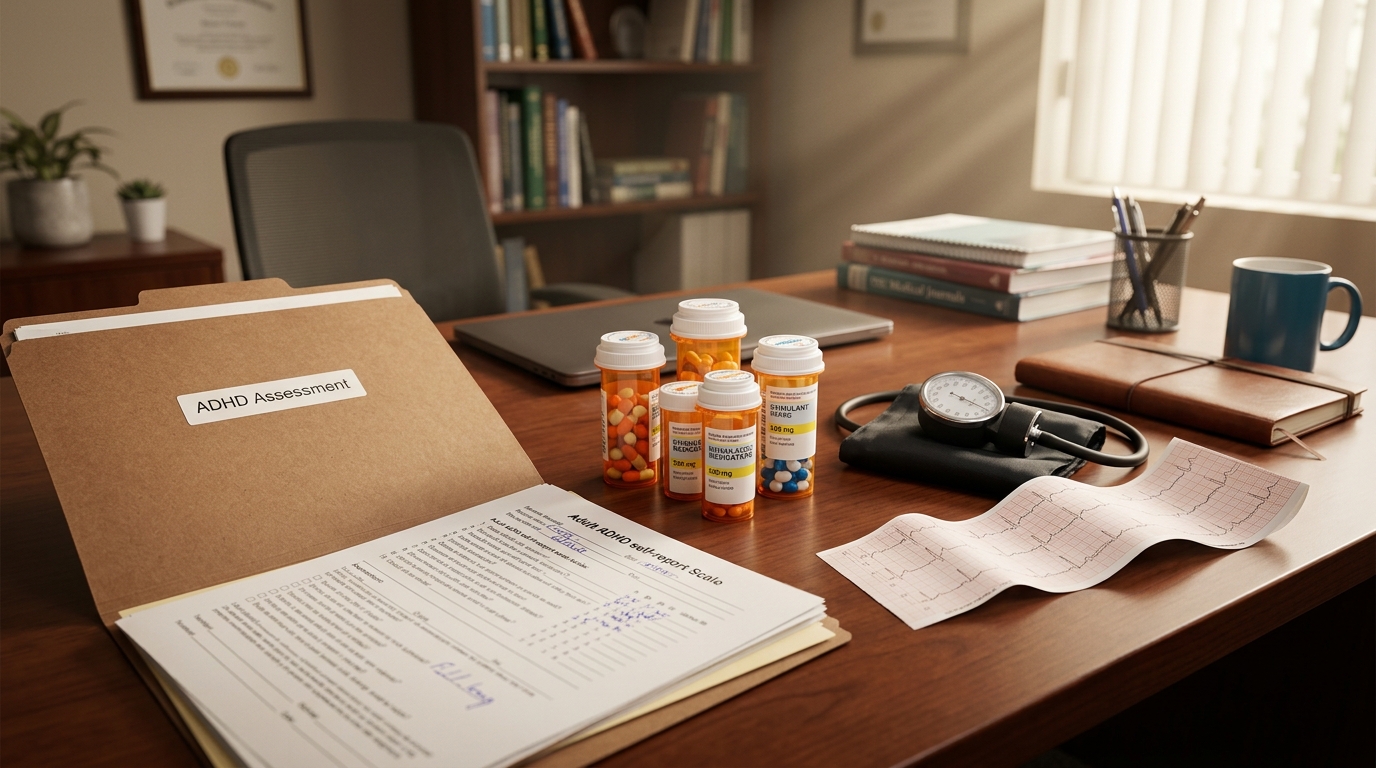
Diagnostic Approach in Adults
ADHD in adults is underdiagnosed and undertreated — a substantial number of adults with functional impairment from attention deficit symptoms were never identified in childhood or were diagnosed but discontinued treatment during adolescence. For the psychiatrist, primary care physician, or neurologist evaluating an adult with concentration difficulties, organizational problems, and functional impairment, establishing the diagnosis requires careful assessment that distinguishes ADHD from the many conditions that mimic it. Once diagnosed, stimulant selection and cardiovascular monitoring represent the key management decisions.
Adult ADHD diagnosis requires documentation of symptoms before age 12, current functional impairment in 2 or more domains, and exclusion of alternative explanations. The Adult ADHD Self-Report Scale (ASRS-v1.1) serves as a validated screening tool with sensitivity of 68.7% and specificity of 99.5% for the 6-item screener[3]. The DIVA-5 (Diagnostic Interview for ADHD in Adults) provides a structured diagnostic assessment aligned with DSM-5 criteria. Clinicians should assess for common comorbidities: 60-80% of adults with ADHD have at least one psychiatric comorbidity, most frequently anxiety disorders (47%), mood disorders (38%), and substance use disorders (15-25%)[1].
Stimulant Pharmacotherapy: Head-to-Head Evidence
Stimulants remain first-line treatment with effect sizes (Cohen's d) of 0.8-1.0 for symptom reduction, the largest of any psychiatric medication class. The landmark network meta-analysis by Cortese et al. (2018, Lancet Psychiatry) found amphetamines more efficacious than methylphenidate in adults (SMD -0.79 versus -0.49)[1], while methylphenidate was better tolerated (discontinuation due to adverse effects: OR 1.0 versus 2.0 for amphetamines). Extended-release formulations are preferred for adherence: lisdexamfetamine (30-70 mg daily), mixed amphetamine salts XR (10-30 mg daily), methylphenidate OROS (18-72 mg daily), or dexmethylphenidate XR (10-40 mg daily).
Non-Stimulant Options
Atomoxetine (40-100 mg daily) is the best-studied non-stimulant with an effect size of 0.4-0.5. Onset of full efficacy requires 4-6 weeks. Viloxazine ER (200-600 mg daily) received FDA approval for adult ADHD in 2024 based on phase 3 data showing significant improvement in ADHD-RS-IV total scores versus placebo (LS mean difference -5.9, p<0.001)[4]. Guanfacine ER and clonidine ER, while FDA-approved only for pediatric ADHD, are used off-label in adults, particularly for hyperactivity-impulsivity symptoms and stimulant-related insomnia.
Cardiovascular Safety Monitoring
Stimulants produce average increases of 2-5 mmHg in systolic blood pressure and 1-3 mmHg in diastolic blood pressure, with heart rate increases of 3-6 bpm[2]. The large retrospective cohort study by Habel et al. (2011, JAMA) found no increased risk of serious cardiovascular events among 150,359 adult stimulant users (adjusted RR 0.83, 95% CI 0.72-0.96)[2]. Pre-treatment assessment should include blood pressure, heart rate, and personal/family cardiac history. ECG is not routinely recommended (AHA/AAP guidelines) unless cardiac history is positive. Monitor blood pressure at each visit for the first 3 months, then every 6 months.
Special Populations and Comorbidity Management
In patients with comorbid anxiety, atomoxetine or stimulant plus SSRI combination is effective (see also bipolar disorder screening before SSRI initiation), with the latter showing no significant pharmacokinetic interactions. For active substance use disorder, extended-release formulations with lower abuse liability (lisdexamfetamine, methylphenidate OROS) are preferred, though current evidence from the SOSTRA trial does not support withholding stimulants during stable recovery. Patients with concurrent concussion history may present with overlapping cognitive symptoms. In hypertensive patients, stimulant initiation is reasonable if blood pressure is controlled below 140/90 mmHg, with closer monitoring (every 2-4 weeks initially) and antihypertensive adjustment as needed.
The Diagnostic Challenge: Distinguishing ADHD from Its Mimics
The most important step in adult ADHD management is getting the diagnosis right. Concentration difficulties, forgetfulness, and executive dysfunction are common to many conditions — depression, anxiety, sleep disorders, thyroid disease, substance use, and the cognitive effects of chronic pain or medications can all produce symptoms that overlap substantially with ADHD. A careful clinical history should establish that attention and organizational symptoms were present before age twelve, that they occur across multiple domains (work, home, relationships — not just the specific setting the patient finds most stressful), and that they are not better explained by another diagnosis. Neuropsychological testing can be helpful in ambiguous cases but is not required for diagnosis and should not delay treatment when the clinical picture is clear.
Limitations and the Stigma Factor
Adult ADHD treatment faces two persistent barriers: the diagnostic uncertainty that leads to both overdiagnosis (particularly in patients seeking stimulant prescriptions for performance enhancement) and underdiagnosis (in women, older adults, and patients whose symptoms present as disorganization and emotional dysregulation rather than hyperactivity), and the stigma that prevents many patients from seeking evaluation at all. The cardiovascular safety data for stimulants are reassuring in aggregate — large cohort studies show no significant increase in serious cardiovascular events in adults without pre-existing cardiac disease — but individualized risk assessment remains important, particularly in patients over fifty or those with structural heart disease. The field would benefit from better biomarkers for diagnosis and treatment response, but for now, careful clinical assessment remains the foundation of care.
References
- Comparative efficacy and tolerability of medications for attention-deficit hyperactivity disorder in children, adolescents, and adults: a systematic review and network meta-analysis PubMed 29033005
- ADHD medications and risk of serious cardiovascular events in young and middle-aged adults PubMed 21464083
- Validity of the World Health Organization Adult ADHD Self-Report Scale (ASRS) Screener in a representative sample of health plan members PubMed 29177453
- Viloxazine extended-release for the treatment of ADHD in adults: a phase 3 randomized, double-blind, placebo-controlled trial PubMed 35896943
Frequently Asked Questions
Are amphetamines or methylphenidate more effective for adult ADHD?
Do stimulants increase cardiovascular risk in adults?
Is routine ECG needed before starting stimulants for ADHD?
What is the effect size of atomoxetine vs stimulants for ADHD?
Which stimulant formulation is preferred in adults with substance use disorder?
What validated screening tools exist for adult ADHD diagnosis?
Explore This Topic in Ailva
Ailva is a free clinical intelligence platform for NPI-verified US physicians. Get evidence-based answers with verified citations from 16M+ indexed papers — plus free CME credits.
Founder of Ailva.ai | Former Director of Research and Author of 200+ Medically Reviewed Articles | Editor-in-Chief of EudaLife Magazine