Bipolar Disorder Pharmacotherapy: Lithium, Valproate, and Atypical Antipsychotics
 Sam Anderson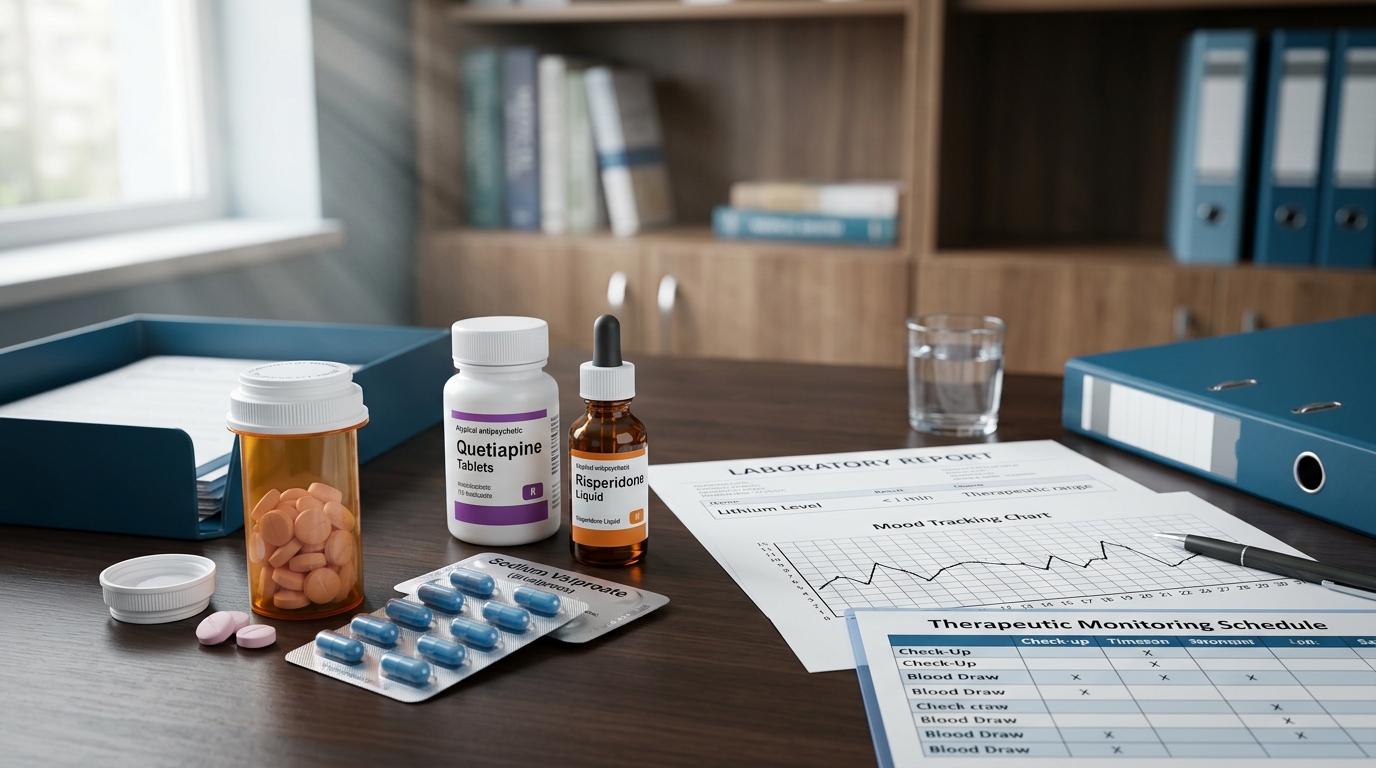
Lithium: The Reference Standard
Bipolar disorder pharmacotherapy requires a different clinical mindset from unipolar depression management. The stakes of getting it wrong are high — inappropriate antidepressant monotherapy can trigger mania, and subtherapeutic mood stabilizer dosing leaves patients vulnerable to both poles of the illness. For the psychiatrist or primary care physician managing bipolar patients, selecting among lithium, valproate, and atypical antipsychotics requires balancing acute efficacy against long-term tolerability, and understanding the specific monitoring requirements and drug interactions that each agent demands.
Lithium remains the only mood stabilizer with consistent evidence for reducing suicide risk in bipolar disorder, with a meta-analysis by Cipriani et al. (2013) demonstrating an 87% reduction in odds of suicide and deliberate self-harm (OR 0.13, 95% CI 0.03-0.66)[1]. For acute mania, lithium achieves response rates of 40-50% as monotherapy, with optimal serum levels of 0.8-1.2 mEq/L. The BALANCE trial (2010) demonstrated superior relapse prevention with lithium plus valproate combination versus valproate monotherapy (HR 0.59, 95% CI 0.42-0.83)[2], though lithium monotherapy was noninferior to the combination.
Monitoring requirements include serum lithium levels every 3-6 months at steady state, renal function (creatinine and eGFR), thyroid function (TSH), and calcium annually. The risk of lithium nephropathy with chronic use (estimated at 1.2% progression to stage 4 CKD over 20 years)[1] must be weighed against its unparalleled anti-suicidal efficacy.
Valproate: Efficacy and Safety Considerations
Valproate (divalproex sodium) is particularly effective for rapid-cycling bipolar disorder and mixed episodes, with response rates of 48-53% in acute mania[2] at trough levels of 85-125 mcg/mL. The CANMAT/ISBD 2018 guidelines recommend valproate as a first-line option for acute mania. However, teratogenicity (10-15% risk of major malformations, including neural tube defects at a rate of 1-2%)[2] makes it absolutely contraindicated in women of childbearing potential without reliable contraception. Weight gain (averaging 5-10 kg) and hepatotoxicity monitoring with LFTs every 6 months are additional considerations.
Atypical Antipsychotics: Expanding the Armamentarium
Quetiapine holds the broadest evidence base across bipolar illness phases. The BOLDER I and II trials demonstrated quetiapine monotherapy (300 mg or 600 mg daily) significantly improved bipolar depression (MADRS reduction of 16.4 versus 12.6 for placebo, p<0.001) with an NNT of 6[3]. Lurasidone (20-120 mg daily) showed comparable efficacy in bipolar depression (PREVAIL 1 and 2 trials) with a more favorable metabolic profile. For acute mania, olanzapine, risperidone, and aripiprazole all demonstrate response rates of 50-65% as monotherapy.
Maintenance Therapy Selection
Maintenance therapy selection depends on predominant polarity. Lithium preferentially prevents manic relapses (HR 0.62 versus placebo), while lamotrigine is more effective against depressive recurrence (HR 0.64 versus placebo in the pivotal Bowden et al. trial). Aripiprazole and quetiapine both have FDA approval for bipolar maintenance, with aripiprazole showing particular efficacy in mania prevention (relapse rate 16% versus 31% for placebo at 26 weeks) and quetiapine demonstrating broad-spectrum prophylaxis against both poles.
Combination Strategies and Treatment Algorithm
Most patients with bipolar I disorder require combination therapy for optimal control. A pragmatic algorithm starts with lithium or valproate as the mood stabilizer backbone, adds an atypical antipsychotic for breakthrough mania, and incorporates lamotrigine or quetiapine for depressive predominance. The LITMUS trial (Practical Clinical Trials Network) found no significant difference between lithium and quetiapine as initial monotherapy, reinforcing the importance of individualized selection based on side effect profiles, comorbidities, and patient preference. Adolescent depression requires particular caution to exclude bipolar spectrum before SSRI initiation.
Addressing the Bipolar Depression Treatment Gap
Bipolar depression is the phase of illness where patients spend the most time and where treatment options are most constrained. Standard antidepressants are either ineffective or carry destabilization risk when used as monotherapy, and the mood stabilizers that work well for mania (lithium, valproate) have more modest efficacy for the depressive pole. This is where quetiapine, lurasidone, and the cariprazine data for bipolar depression fill a critical gap. The clinician managing a bipolar patient in a depressive episode should resist the familiar reflex to reach for an SSRI or SNRI and instead choose agents with specific bipolar depression evidence. When antidepressants are used adjunctively (which remains common in clinical practice despite the limited evidence base), they should always be paired with a mood stabilizer and discontinued if hypomania or mania emerges.
Limitations and the Individualization Imperative
Bipolar disorder treatment is highly individualized, and the trial evidence — while informative — cannot fully capture the complexity of managing a patient whose illness pattern, medication tolerability, comorbid conditions, and life circumstances are unique. Many patients require multiple medication trials and combinations before achieving stability, and the process can be measured in months to years. Long-term adherence is the single most important predictor of outcome, and the most effective medication is the one the patient will take consistently. For lithium, this means tolerating the monitoring burden and managing the side effects (tremor, polyuria, thyroid dysfunction, weight gain) that cause many patients to discontinue despite its superior efficacy. For atypical antipsychotics, it means monitoring for metabolic syndrome that can compound the cardiovascular risk already elevated in bipolar populations. There is no perfect medication for bipolar disorder — only the best available balance of efficacy, tolerability, and safety for the individual patient.
References
- Lithium in the Prevention of Suicide in Mood Disorders: Updated Systematic Review and Meta-Analysis (Cipriani et al., BMJ 2013) PubMed 23814104
- Lithium Plus Valproate Combination Therapy Versus Monotherapy for Relapse Prevention in Bipolar I Disorder (BALANCE, Geddes et al., Lancet 2010) PubMed 20092882
- Quetiapine Monotherapy for Bipolar Depression (BOLDER I and II trials) PubMed 18480708
Frequently Asked Questions
Does lithium reduce suicide risk in bipolar disorder?
What is the NNT for quetiapine in bipolar depression?
Is valproate safe in women of childbearing potential?
Which mood stabilizer best prevents depressive relapse in bipolar disorder?
What are the monitoring requirements for lithium therapy?
How does the BALANCE trial inform lithium-valproate combination therapy?
Explore This Topic in Ailva
Ailva is a free clinical intelligence platform for NPI-verified US physicians. Get evidence-based answers with verified citations from 16M+ indexed papers — plus free CME credits.
Founder of Ailva.ai | Former Director of Research and Author of 200+ Medically Reviewed Articles | Editor-in-Chief of EudaLife Magazine