Colorectal Cancer Screening: Age 45 Start and Stool-Based vs Colonoscopy
 Sam Anderson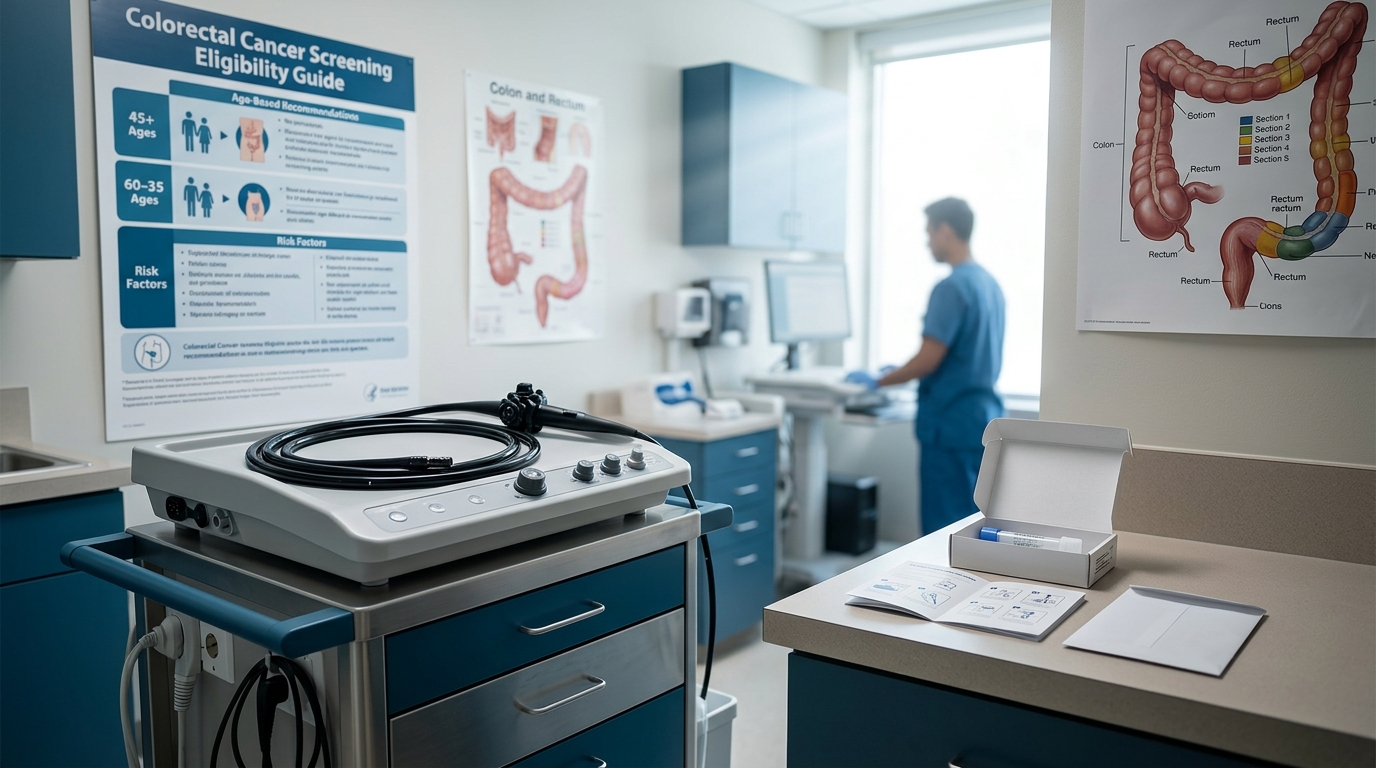
Why Screening at 45: The Epidemiologic Shift
Colorectal cancer screening is one of the most impactful cancer prevention strategies available, with the potential to both detect cancer early and prevent it entirely through polyp removal. The lowering of the recommended screening age to 45 has expanded the eligible population substantially. For the primary care physician, gastroenterologist, or internist, implementing effective CRC screening requires navigating multiple test options, understanding which patients need earlier or more intensive screening, and counseling patients through the decision between stool-based testing and direct visualization methods.
CRC incidence in adults aged 20-49 has increased by approximately 2% annually since the mid-1990s[1], with adults aged 45-49 bearing the highest absolute burden among early-onset cases. The USPSTF, ACS, and ACG now uniformly recommend initiating average-risk CRC screening at age 45, paralleling lowered thresholds in breast cancer screening, extending through age 75 with shared decision-making for ages 76-85. This change expanded the screening-eligible population by approximately 20 million adults. Any recommended screening test is preferable to no screening, and the optimal test is the one the patient will complete.
Colonoscopy: The Reference Standard with Nuanced Data
The NordICC trial, the first randomized trial of screening colonoscopy, demonstrated a 31% reduction in CRC risk in the per-protocol analysis[2] (patients who actually underwent colonoscopy) but only an 18% reduction in the intention-to-screen analysis (hampered by 42% non-adherence)[2]. CRC mortality reduction was 50% in the per-protocol analysis[2]. Colonoscopy offers the advantage of being both diagnostic and therapeutic (polypectomy during the same procedure) with a 10-year screening interval. Limitations include bowel preparation burden, sedation requirements, and a small but real complication rate: perforation (3-8 per 10,000), significant bleeding (5-10 per 10,000), and sedation-related adverse events.
FIT and FIT-DNA: Non-Invasive Alternatives
Annual fecal immunochemical testing (FIT) has a sensitivity of 74% for CRC and 24% for advanced adenomas per round[3], with cumulative sensitivity approaching that of colonoscopy over serial annual testing. FIT-DNA (Cologuard, multi-target stool DNA) has higher per-test sensitivity for CRC (92-94%) and advanced adenomas (42%) but lower specificity (87% vs 96% for FIT)[3], resulting in higher false positive rates and is performed every 3 years. The BLUE-C trial evaluating next-generation Cologuard Plus showed improved specificity (90.6%) while maintaining CRC sensitivity (93.9%)[4], potentially addressing the false positive limitation.
Blood-Based Tests: The Shield and CancerSEEK Horizon
The Shield blood test (Guardant Health, FDA-approved 2024) detects CRC using cell-free DNA methylation patterns with 83% sensitivity for CRC, 13% for advanced adenomas, and 90% specificity[5]. While CRC sensitivity is lower than stool-based tests, the convenience of a routine blood draw may improve screening participation rates significantly. The test is performed every 3 years. Blood-based screening is best positioned for patients who have declined or are non-adherent to colonoscopy and stool-based testing. Patients with hereditary cancer syndromes require more intensive colonoscopic surveillance, rather than as a replacement for higher-sensitivity options in engaged patients.
Choosing the Right Test: A Patient-Centered Approach
For patients willing to undergo colonoscopy with adequate bowel preparation: screening colonoscopy every 10 years remains the gold standard. IBD patients follow separate surveillance protocols. For patients preferring non-invasive testing: annual FIT offers the best balance of sensitivity, specificity, and cost-effectiveness. FIT-DNA every 3 years is reasonable for patients who prefer less frequent testing. Blood-based screening is appropriate when patients decline both colonoscopy and stool-based options. All positive non-invasive tests require follow-up colonoscopy. The critical message for clinicians: the most effective screening test is the one the patient will actually complete consistently.
The Follow-Up Problem
The Achilles heel of non-invasive CRC screening is the follow-up colonoscopy for positive results. A positive FIT or FIT-DNA test that is not followed by a diagnostic colonoscopy within a reasonable timeframe — ideally within 60 days — negates the screening benefit entirely. Studies consistently show that a substantial proportion of positive stool-based tests are not followed by colonoscopy, with rates of non-follow-up as high as 30-50% in some healthcare systems. The reasons are familiar: scheduling delays, patient anxiety about the procedure, lack of coordinated follow-up systems, and the same access barriers that led patients to choose non-invasive testing in the first place. Building automated tracking systems that flag positive stool tests and ensure colonoscopy scheduling is as important as choosing the right screening modality.
Limitations and Evolving Questions
The NordICC trial produced smaller-than-expected reductions in CRC incidence on intention-to-screen analysis, driven largely by low adherence — a finding that has been alternately interpreted as evidence that colonoscopy is less effective than assumed and as evidence that the most important barrier to CRC prevention is not test performance but test completion. Blood-based tests offer an exciting new option for engaging non-screened populations but have lower sensitivity for advanced adenomas — meaning they are better at detecting existing cancers than preventing future ones through polyp removal. The optimal screening strategy for the 45-49 age group specifically, where CRC incidence is rising but the absolute number of cancers remains lower than in older populations, continues to be refined as data accumulate in this newly eligible cohort.
References
- Colorectal cancer incidence trends in young adults. PubMed 35179323
- Bretthauer M, et al. Effect of Colonoscopy Screening on Risks of Colorectal Cancer and Related Death (NordICC). PubMed 36214590
- Imperiale TF, et al. Multitarget Stool DNA Testing for Colorectal-Cancer Screening. PubMed 24645800
- Next-Generation Multitarget Stool DNA Test for Colorectal Cancer Screening (BLUE-C). PubMed 38477986
- Cell-free DNA Blood-based Test for Colorectal Cancer Screening (Shield/ECLIPSE trial). PubMed 39467291
Frequently Asked Questions
What did the NordICC trial show for screening colonoscopy?
What is the sensitivity of FIT-DNA (Cologuard) for colorectal cancer?
How does the Shield blood test compare to stool-based CRC screening?
Why was the CRC screening age lowered to 45?
What is the sensitivity of annual FIT for colorectal cancer?
When should blood-based CRC screening be offered over FIT or colonoscopy?
Explore This Topic in Ailva
Ailva is a free clinical intelligence platform for NPI-verified US physicians. Get evidence-based answers with verified citations from 16M+ indexed papers — plus free CME credits.
Founder of Ailva.ai | Former Director of Research and Author of 200+ Medically Reviewed Articles | Editor-in-Chief of EudaLife Magazine