Parkinson's Disease: Levodopa Optimization and Adjunctive Therapies
 Sam Anderson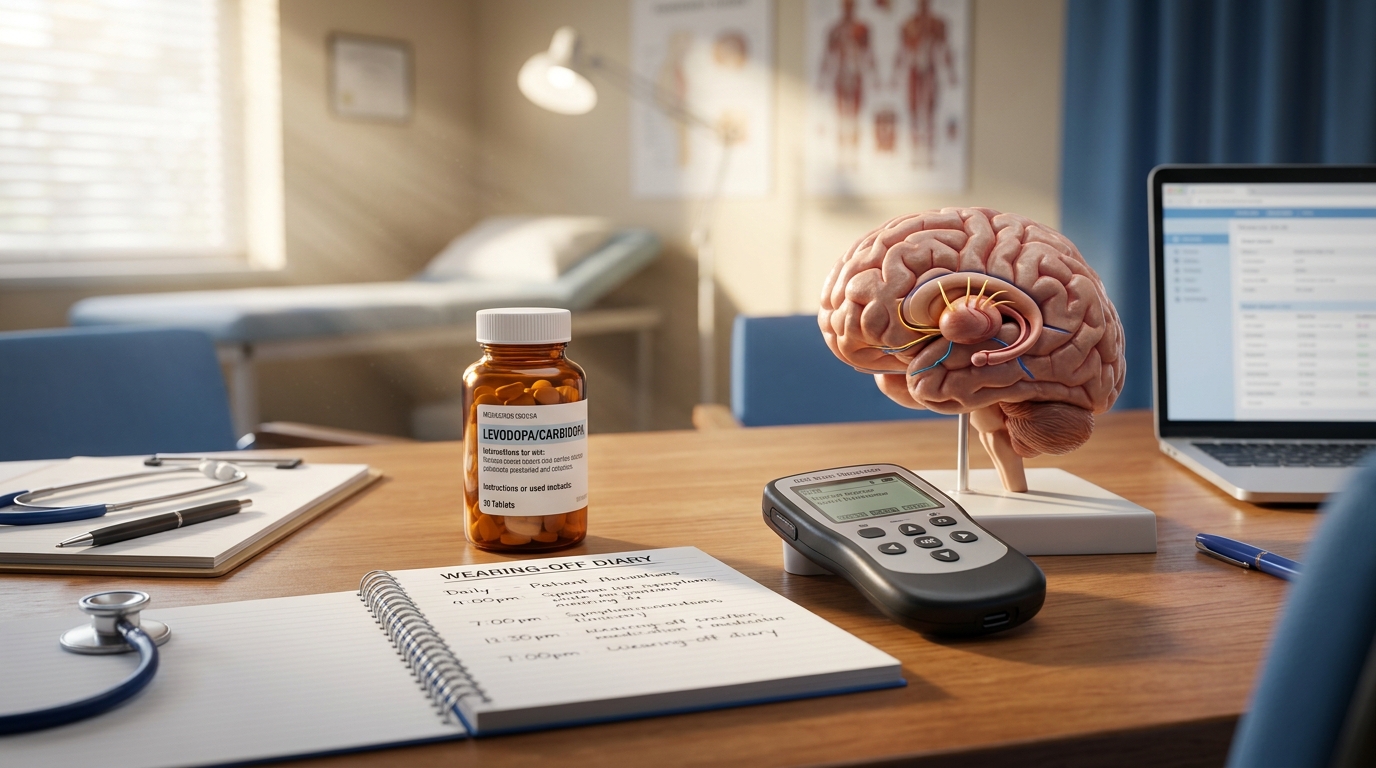
Levodopa Initiation: Timing and Initial Dosing
Parkinson's disease management centers on optimizing dopaminergic therapy while managing the inevitable motor complications that emerge with long-term levodopa use. For the neurologist, movement disorder specialist, or primary care physician co-managing a PD patient, the clinical challenge is not whether to use levodopa — it remains the most effective symptomatic therapy — but when to start, how to dose, when to add adjunctive agents, and how to manage the wearing-off, dyskinesia, and motor fluctuations that characterize advancing disease.
The PD MED trial (2014, n=1,620) and the subsequent LEAP trial (2019, n=445) definitively addressed the levodopa timing debate. LEAP demonstrated no difference in outcomes between early versus delayed levodopa initiation over 80 weeks, establishing that levodopa does not accelerate disease progression[1]. Current MDS guidelines recommend levodopa as first-line therapy for patients with significant motor disability, starting at 100 mg carbidopa/levodopa three times daily (with a minimum of 75 mg carbidopa daily to ensure adequate peripheral decarboxylase inhibition). Dose titration proceeds in 100 mg levodopa increments every 1-2 weeks until satisfactory motor control is achieved, typically at 300-600 mg daily of levodopa equivalent dose.
Managing Motor Fluctuations
Wearing-off phenomena are managed by fractionating the levodopa dose (more frequent, smaller doses), adding a COMT inhibitor (entacapone 200 mg with each levodopa dose, or opicapone 50 mg daily), or adding a MAO-B inhibitor (rasagiline 1 mg daily or safinamide 50-100 mg daily). The OPTIPARK trial showed opicapone increased daily ON time by 1.0 hour compared to placebo[4] with fewer dyskinesia concerns than entacapone. For troublesome dyskinesia, amantadine extended-release (274 mg daily) reduced dyskinesia duration by 27% in the EASE LID 3 trial[7]. Continuous subcutaneous foslevodopa-foscarbidopa (Produodopa) infusion, FDA-approved in 2024, provides steady-state levodopa plasma levels and reduced OFF time by 1.75 hours versus oral levodopa in the M15-736 trial.
Dopamine Agonists and MAO-B Inhibitors
Dopamine agonists (pramipexole 0.5-1.5 mg TID, ropinirole 3-8 mg TID, or rotigotine transdermal 2-8 mg/24h) are appropriate as initial monotherapy in younger patients (under 60) with mild symptoms, delaying levodopa-associated motor complications. However, impulse control disorders occur in 14-24% of patients (DOMINION study)[3], and excessive daytime sleepiness in 15-20%. Seizure risk should also be considered in dopamine agonist selection. MAO-B inhibitors provide modest symptomatic benefit as monotherapy in early disease (rasagiline showed 2-3 point UPDRS improvement in the ADAGIO trial[5]) and meaningful adjunctive benefit in fluctuating disease. Safinamide uniquely combines MAO-B inhibition with sodium channel blockade and glutamate release inhibition.
Deep Brain Stimulation and Device Therapies
Subthalamic nucleus deep brain stimulation (STN-DBS) is indicated for motor fluctuations refractory to medication optimization. The EARLYSTIM trial demonstrated benefit of STN-DBS when initiated earlier in the motor fluctuation course (mean disease duration 7.5 years) compared to best medical therapy, with a 26% improvement in PDQ-39 quality of life score (p<0.001)[2]. Patient selection criteria include clear levodopa responsiveness (above 30% improvement on motor UPDRS), absence of significant cognitive impairment (Mattis Dementia Rating Scale above 130), and absence of uncontrolled psychiatric disease. MRI-guided focused ultrasound (MRgFUS) thalamotomy for tremor-dominant PD is an alternative for patients who are not DBS candidates, achieving tremor reduction of 62% at 1 year (BEST-FUS trial).
Non-Motor Symptom Management
Non-motor symptoms affect over 90% of PD patients and often dominate quality of life. For REM sleep behavior disorder (present in 25-50%), melatonin 3-12 mg at bedtime is first-line with fewer side effects than clonazepam (0.25-2 mg). PD-associated constipation responds to macrogol (polyethylene glycol) and lubiprostone (24 mcg twice daily). Cognitive impairment in PD (PDD), distinct from Alzheimer's disease, is treated with rivastigmine (up to 12 mg daily oral or 13.3 mg/24h transdermal), which showed modest but significant improvement in ADAS-cog scores in the EXPRESS trial (NNT of 6 for clinically meaningful improvement)[6]. For PD-associated depression, duloxetine and nortriptyline are preferred over SSRIs based on the SADPD trial results[8].
When to Refer for Device-Aided Therapy
The EARLYSTIM data — showing benefit when STN-DBS is initiated at a mean disease duration of 7.5 years rather than waiting for advanced disease — challenge the traditional approach of deferring device therapy until oral medications have been thoroughly exhausted. The practical referral trigger should be the emergence of motor fluctuations that meaningfully impact daily function despite opicapone, MAO-B inhibitors, and optimized levodopa dosing intervals. Waiting until the patient has progressed to the point of severe disability makes the surgical evaluation more complex and the rehabilitation harder. The same urgency applies to the continuous subcutaneous foslevodopa-foscarbidopa infusion now available — these therapies work best when introduced while the patient still has meaningful levodopa responsiveness and cognitive capacity to participate in the rehabilitation process.
Limitations and the Non-Motor Blind Spot
The motor focus of PD therapeutics obscures the reality that non-motor symptoms — affecting over 90% of patients — often dominate quality of life in ways that no amount of levodopa optimization can address. The rivastigmine NNT of 6 for PDD is meaningful but modest, and no therapy halts the cognitive decline that progresses in the majority of PD patients over time. Impulse control disorders from dopamine agonists (14-24% in the DOMINION data) can be devastating to patients and families, and the LEAP trial's reassuring conclusion that levodopa does not accelerate progression, while important, does not resolve the fundamental limitation that all current PD therapy is symptomatic. Every medication decision described in this article optimizes life within a progressive disease — it does not change the trajectory. Communicating this honestly to patients and families, while still conveying that meaningful improvements in daily function and quality of life are consistently achievable with the tools available, is one of the most important aspects of PD care.
References
- Randomized Delayed-Start Trial of Levodopa in Parkinson's Disease PubMed 30511573
- Neurostimulation for Parkinson's disease with early motor complications PubMed 23406026
- Impulse control disorders in Parkinson disease: a cross-sectional study of 3090 patients PubMed 21416496
- OPTIPARK: a real-world study to assess the effectiveness and safety of opicapone in Parkinson's disease PubMed 33428178
- A double-blind, delayed-start trial of rasagiline in Parkinson's disease PubMed 19776408
- Rivastigmine for dementia associated with Parkinson's disease PubMed 15590953
- Amantadine extended release for levodopa-induced dyskinesia in Parkinson's disease (EASE LID 3): a Phase 3 randomised double-blind trial PubMed 29780852
- A randomized, double-blind, placebo-controlled trial of antidepressants in Parkinson disease PubMed 22021174
Frequently Asked Questions
Does early levodopa initiation accelerate Parkinson's disease progression?
What is the best COMT inhibitor for levodopa wearing-off?
What are the selection criteria for subthalamic DBS in Parkinson's disease?
What is the incidence of impulse control disorders with dopamine agonists?
What is the NNT for rivastigmine in Parkinson's disease dementia?
What is foslevodopa-foscarbidopa for Parkinson's motor fluctuations?
Explore This Topic in Ailva
Ailva is a free clinical intelligence platform for NPI-verified US physicians. Get evidence-based answers with verified citations from 16M+ indexed papers — plus free CME credits.
Founder of Ailva.ai | Former Director of Research and Author of 200+ Medically Reviewed Articles | Editor-in-Chief of EudaLife Magazine